
Popular Calculators
Home » Body Type Calculator
Body Type Calculator
Use this Body Type Calculator to estimate your body shape from four measurements: shoulders, bust or chest, waist, and hips. Choose inches or centimeters, enter every value in the same unit, and select Calculate. The tool compares your upper-body, waist, and hip proportions before returning Hourglass, Pear or Triangle, Inverted Triangle, Rectangle, or Balanced. The result describes measurement proportions for general information, clothing planning, and size comparison. It does not determine ectomorph, mesomorph, or endomorph, and it is not a medical or fitness assessment.
Body Type Calculator
Measurement Unit:
Estimated Body Type:
Summary:
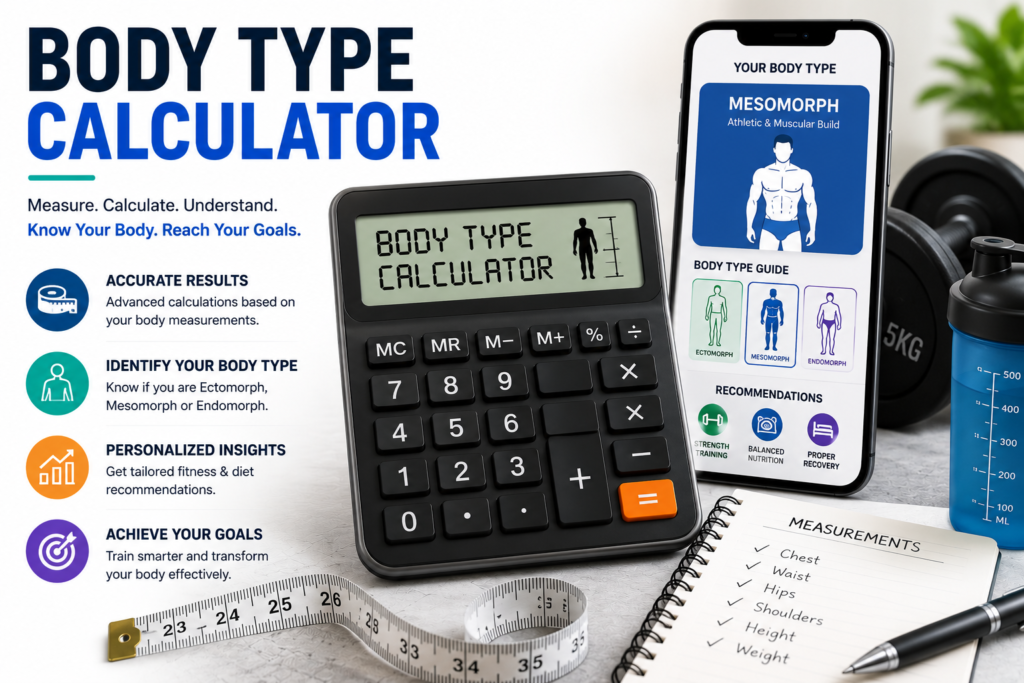
Body Type Calculator for Clear Measurement-Based Results
A Body Type Calculator gives you a consistent way to compare the main circumferences of your torso. Instead of choosing a shape by looking at a mirror or relying on a clothing label, you enter four numbers and let the same comparison rules evaluate them. Therefore, the result is based on proportions rather than height, weight, age, or personal opinion.
This page is designed for people who want a quick body-shape estimate for clothing, styling, measurement tracking, or general curiosity. It uses the larger of your shoulder and bust or chest measurements as the upper-body value. Next, it compares that value with your hips and waist. As a result, the calculation reflects the fields that appear in the tool and does not claim to measure metabolism, muscle-building potential, body fat, or health.
Body proportions can sit close to more than one category. In addition, a small measuring difference can move a result across a threshold. For that reason, treat the output as a practical description, not a fixed identity. You can repeat the measurement, review the method below, and use the result alongside a garment brand’s own size chart.
What Does the Body Type Calculator Measure?
The calculator uses shoulder, bust or chest, waist, and hip circumference. Each number describes one horizontal area of the body. However, the tool does not use height or weight because its purpose is to compare shape, not overall body size. Two people can have very different measurements and still receive the same category when their proportions are similar.
The tool first identifies the larger of the shoulder and bust or chest values. It calls this the upper-body measurement for the calculation. Then, it compares that number with the hip measurement. Finally, it checks the waist in relation to the upper body. This order matters because the category rules are applied in sequence.
You may choose inches or centimeters. Since the result depends on ratios and percentage differences, the chosen unit does not change the category when every value uses the same unit. For example, a set of correctly converted centimeter measurements has the same proportions as the original inch measurements. Mixing units, however, produces a meaningless result.
Measurements used by the body shape calculator
- Shoulders: the circumference around the broadest part of the shoulders, with the tape kept level.
- Bust or chest: the circumference around the fullest part of the bust or chest, without pulling the tape tightly.
- Waist: the circumference at the measurement point you use consistently as your natural waist.
- Hips: the circumference around the fullest part of the hips and seat, with feet placed naturally.
Measurement protocols can differ, especially for the waist. Therefore, consistency matters more than switching between several methods during one comparison. The U.S. National Center for Health Statistics has published detailed research on waist-circumference measurement methods. That research also shows why the selected measurement site should be stated clearly when figures are compared.
How to Use This Body Type Calculator
Start with a flexible, non-stretch measuring tape. Wear light, close-fitting clothing or measure over a thin layer. Stand in a natural position, breathe normally, and keep the tape parallel to the floor. Moreover, do not pull the tape so tightly that it compresses the body.
- Select Inches or Centimeters under Measurement Unit.
- Measure and enter the shoulder circumference.
- Enter the bust or chest circumference in the same unit.
- Enter the waist circumference.
- Enter the hip circumference.
- Check all four values, then select Calculate.
- Read the estimated body type and the short result summary.
The fields accept positive numbers, including decimals. However, zero, negative values, empty fields, and non-numeric entries are rejected. If an alert appears, check that every field contains a valid measurement. Also, confirm that you did not enter inches in one field and centimeters in another.
For better repeatability, take each measurement twice. If the two readings differ, measure a third time and use the closest pair. In addition, keep the same posture and tape position. A difference caused by a tilted tape or a changed waist location can affect the result more than the calculator’s arithmetic.
Body Type Calculator Formula and Classification Rules
The Body Type Calculator does not use a single medical formula. Instead, it applies a set of proportion rules. First, it defines the upper-body value as the larger of the shoulder measurement and the bust or chest measurement:
Upper body = maximum of shoulders and bust/chest
It then treats the hip measurement as the lower-body value:
Lower body = hips
Next, the tool checks the following rules in order. Because the first matching rule is used, the sequence is part of the calculation.
- Hourglass: the difference between upper body and hips is no more than 5% of the upper-body value, while the waist is less than 75% of the upper-body value.
- Pear or Triangle: hips are more than 5% larger than the upper-body value.
- Inverted Triangle: the upper-body value is more than 5% larger than the hips.
- Rectangle: none of the earlier rules applies, and the waist is at least 85% of the upper-body value.
- Balanced: the measurements do not meet any of the four earlier conditions.
These thresholds create a simple estimate that is easy to repeat. Nevertheless, real bodies have more variation than five labels can describe. The calculator does not include torso length, shoulder structure, body composition, posture, or how measurements are distributed visually. Therefore, use the label as a broad proportion group.
Understanding Each Body Shape Result
Hourglass body shape
An Hourglass result means the upper-body and hip values are within the calculator’s 5% balance range, while the waist is below 75% of the upper-body value. In other words, the top and lower measurements are similar and the waist is noticeably smaller. However, the result does not require identical bust and hip measurements because the shoulder value may become the upper-body reference.
Pear or Triangle body shape
A Pear or Triangle result means the hips are more than 5% larger than the larger of the shoulders and bust or chest. Consequently, the lower-body circumference is the dominant value in this comparison. The name is descriptive only. It does not indicate weight, health, fitness, or what a person should wear.
Inverted Triangle body shape
An Inverted Triangle result means the upper-body value is more than 5% larger than the hips. Since the tool uses the larger of shoulders and bust or chest, broad shoulders or a larger chest can produce this result. Again, the category describes the entered proportions rather than a health condition.
Rectangle body shape
A Rectangle result appears when the upper and hip values do not trigger Pear or Inverted Triangle, the waist is not small enough for Hourglass, and the waist is at least 85% of the upper-body value. Therefore, the three main levels are relatively close within this rule set.
Balanced body shape
A Balanced result covers figures that do not cross the other thresholds. For example, the upper body and hips may be similar, while the waist lies between the Hourglass and Rectangle limits. This category is useful because it prevents the tool from forcing every close result into a more specific label.
Body Type Calculator Examples
Examples make the rules easier to understand. The following figures use inches, but the same proportions work in centimeters.
Example 1: Hourglass estimate
Assume shoulders are 40, bust is 38, waist is 28, and hips are 39. The upper-body value is 40. The difference between 40 and 39 is 1, while 5% of 40 is 2. Therefore, the upper body and hips are inside the balance range. The waist limit is 75% of 40, which equals 30. Since 28 is below 30, the result is Hourglass.
Example 2: Pear or Triangle estimate
Assume shoulders are 38, bust is 37, waist is 31, and hips are 41. The upper-body value is 38. A value 5% above 38 is 39.9. Since the hip measurement of 41 is greater than 39.9, the result is Pear or Triangle.
Example 3: Inverted Triangle estimate
Assume shoulders are 43, bust is 41, waist is 34, and hips are 38. The upper-body value is 43. The upper-body threshold is more than 5% above the hips. Since 43 is greater than 39.9, which is 38 multiplied by 1.05, the result is Inverted Triangle.
Example 4: Rectangle estimate
Assume shoulders are 39, bust is 38, waist is 35, and hips are 38. The top and hips are close, but the waist is not below the Hourglass limit. In addition, 85% of the upper-body value is 33.15. Since the waist is 35, the result is Rectangle.
Example 5: Balanced estimate
Assume shoulders are 40, bust is 39, waist is 32, and hips are 39. The upper body and hips are within 5%, yet the waist is not below 30, so Hourglass does not apply. The waist is also below 34, which is 85% of 40. Consequently, Rectangle does not apply, and the result is Balanced.
How to Measure for a More Consistent Result
Use the same tape and method for every reading. First, check that the tape is not stretched or twisted. Next, place it around the chosen body area and look in a mirror to see if it stays horizontal. Finally, record the number without rounding it more than necessary.
For shoulders, assistance from another person may improve tape placement. Keep the arms relaxed rather than lifting or flexing them. For the bust or chest, measure around the fullest point and keep the tape level across the back. Meanwhile, avoid taking the measurement immediately after deliberately expanding or emptying the chest.
For the waist, choose one stated method and keep it for future comparisons. For hips, place the tape around the fullest part of the hips and seat. Then, shift the tape slightly up and down to confirm that you found the largest circumference. It may help to measure in front of a full-length mirror.
Time of day, clothing, posture, breathing, and tape tension can all change a reading. Therefore, compare measurements taken under similar conditions. If you are tracking changes, record the date, selected unit, and measurement method beside the numbers.
Body Shape, Somatotype, and Health Are Different Ideas
The term “body type” is used for several different ideas online. This tool calculates a body-shape category from circumference proportions. It does not calculate the somatotypes often called ectomorph, mesomorph, and endomorph. Those labels refer to a different concept and cannot be determined from the four fields in this calculator.
Likewise, the result is not a body-fat estimate. A person’s waist and hip measurements may be relevant in a health assessment, but a shape label alone cannot evaluate health. It also cannot replace body mass index, waist-to-height ratio, clinical measurements, laboratory tests, or advice from a qualified health professional.
Therefore, do not use an Hourglass, Pear, Inverted Triangle, Rectangle, or Balanced result to make medical, nutrition, or exercise decisions. If you have questions about health, body composition, unexpected measurement changes, or exercise safety, speak with an appropriate professional.
Using Your Result for Clothing and Size Planning
A measurement-based result can help you describe where garments may fit differently. For example, a person whose hip measurement is larger than the upper body may need to compare separate top and bottom size charts. Similarly, a person with a larger upper-body measurement may need to prioritize shoulder or chest fit in structured clothing.
However, body shape is not the same as clothing size. Brand charts use finished-garment measurements, body measurements, intended ease, fabric stretch, and product-specific cuts. Therefore, always compare your actual bust or chest, waist, and hip numbers with the chart for the garment you plan to buy.
The result also does not prescribe a style. Clothing choice remains personal. Instead, use the category as search language if it helps you find fitting advice, alteration options, or garment examples. Then, judge each item by comfort, movement, fabric, and the fit you prefer.
Common Mistakes When Using a Body Measurements Calculator
- Mixing inches and centimeters: every input must use the unit selected at the top.
- Measuring only across the front: each field needs a full circumference, not a flat width.
- Pulling the tape too tightly: compression can make the number smaller and change the result.
- Letting the tape slope: a diagonal tape usually records a longer circumference.
- Using different waist points: repeated results are more useful when the same method is used.
- Entering clothing measurements: garment dimensions are not a substitute for body circumferences.
- Treating the category as medical advice: the output is a general shape estimate only.
Another common mistake is using a result that sits very close to a threshold as if it were permanent. For example, a 1 cm measuring difference may change a near-boundary category. If the output seems unexpected, repeat the measurements and compare the raw proportions rather than focusing only on the label.
Limits of This Body Type Calculator
This Body Type Calculator uses a short rule set so that visitors can understand the result. As a result, it cannot capture every body shape or naming system. Some style systems use additional categories, different thresholds, front-view widths, vertical proportions, or separate shoulder and bust comparisons.
The calculator also assumes that all measurements were taken correctly and under similar conditions. It cannot detect an incorrect tape position or an accidental unit mismatch. Moreover, it does not account for pregnancy, medical swelling, recent surgery, asymmetry, mobility limitations, or other circumstances that may make standard measurement methods unsuitable.
Use the output as a starting point. If exact garment fit matters, rely on your measurements and the product’s size chart. If professional pattern drafting or tailoring is involved, a trained fitter may take more measurements, including back width, torso length, high hip, inseam, and shoulder slope.
Related Calculators and Next Steps
You can browse all calculators for other free tools covering health, finance, construction, education, and everyday calculations. If you are tracking a pet rather than personal measurements, the puppy growth estimate tool provides a separate calculation designed for young dogs.
For this page, save the four numbers you entered if you want to compare them later. In addition, note the unit and method. The label can change when the proportions change, but the recorded measurements provide the more useful comparison.
Frequently Asked Questions About the Body Type Calculator
Does the calculator identify ectomorph, mesomorph, or endomorph?
No. It estimates Hourglass, Pear or Triangle, Inverted Triangle, Rectangle, or Balanced from shoulders, bust or chest, waist, and hips. It does not use the fields needed to make claims about somatotype, metabolism, muscle gain, or body-fat tendency.
Can men use this body shape calculator?
Yes. The form accepts shoulder, chest, waist, and hip measurements without asking for sex or gender. However, the category names are broad styling terms, and individual proportions may not match every shape guide.
Should I use inches or centimeters?
Use either unit. The result remains the same when all four values are converted correctly because the calculator compares proportions. Most importantly, never mix the two units in one calculation.
Why did a small measurement change produce a different result?
The rules use 5%, 75%, and 85% thresholds. Therefore, a result close to one of those limits can change after a small difference in tape position, posture, or rounding. Repeat the measurements before drawing a conclusion.
Is this a female body type calculator?
The labels are often used in women’s styling content, but the calculation itself is not restricted to women. It compares the four entered circumferences and returns the same result for the same proportions.
Can this result tell me which clothing size to buy?
No. It can describe proportions, but clothing sizes differ among brands and products. Use your actual measurements with the specific brand’s size chart and review fabric stretch, cut, and intended ease.
Does the result show if I am healthy?
No. A body-shape category is not a medical assessment. It does not measure body fat, fitness, blood pressure, metabolic health, or disease risk. Seek professional advice for health questions.
How often should I take the measurements?
For clothing, take them whenever current fit matters. For general tracking, choose a reasonable interval and repeat the same method under similar conditions. Daily measurement is usually less useful because normal short-term variation can obscure the trend.
Final Note on Your Body Shape Estimate
The Body Type Calculator turns four circumferences into a simple proportion category. It is most useful when the measurements are accurate, the unit is consistent, and the result is treated as descriptive. Therefore, focus on the numbers first and the category second. Use those measurements for practical comparison, check garment-specific size charts, and repeat the calculation if a value appears close to a threshold.