
Popular Calculators
Home » Puppy Weight Calculator
Puppy Weight Calculator
Use our Puppy Weight Calculator to estimate your puppy’s possible adult weight from its current weight, age, and expected adult-size category. Enter the details in kilograms or pounds and choose age in weeks or months. The result is a general planning estimate, not a diagnosis or a substitute for advice from your veterinarian.
Puppy Weight Calculator
Estimated Adult Weight
—
This result is a general estimate based on age, current weight and expected adult-size category. Individual growth can vary.
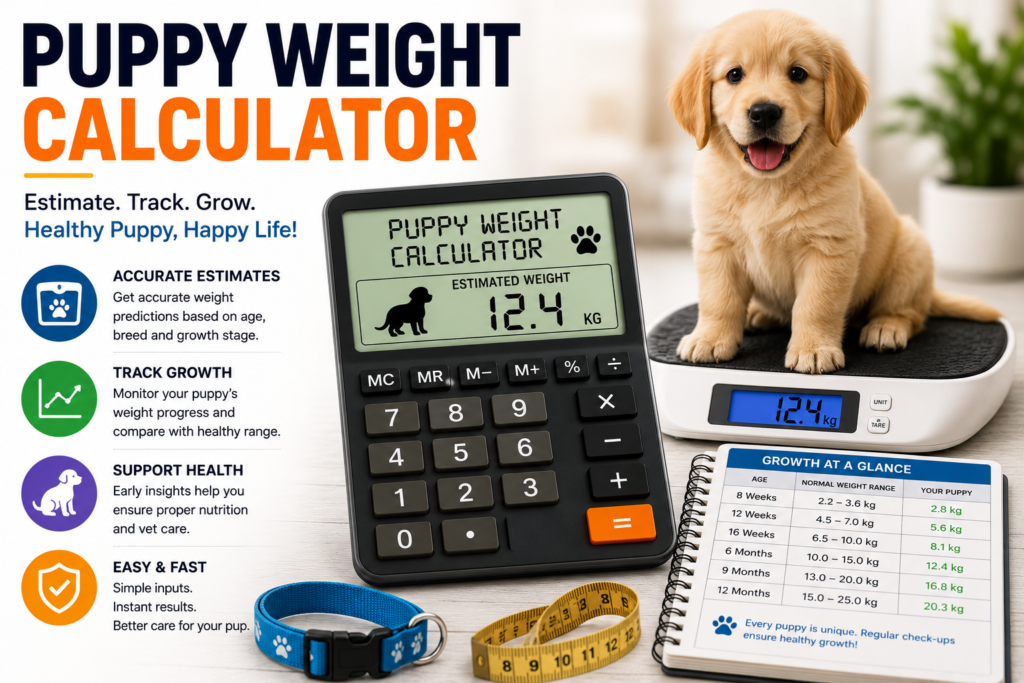
Puppy Weight Calculator: Estimate Your Puppy’s Adult Weight
A Puppy Weight Calculator gives you a general estimate of how much your puppy may weigh as an adult. It uses the puppy’s current weight, age, and expected adult-size category to create the estimate. Therefore, it can provide a useful starting point when you are planning for food storage, bedding, crates, travel equipment, and other practical needs. However, it cannot predict a dog’s final weight with certainty because growth differs among individual puppies.
Puppies do not all grow at the same speed. For example, a toy-size puppy may approach its mature weight much earlier than a large or giant-size puppy. Genetics, sex, nutrition, health, activity, and the accuracy of the information entered can also affect the eventual result. Consequently, two puppies of the same age and current weight may finish at different adult weights.
This Puppy Weight Calculator works with broad adult-size categories rather than named breeds. In other words, selecting “Large Breed” tells the tool to use the general growth profile assigned to large dogs; it does not analyze the puppy’s exact breed or DNA. Mixed-breed puppies can be even harder to predict because their inherited size and growth pattern may come from several different ancestors.
Use the estimate as a practical guide, and then compare it with regular measurements over time. If you are concerned about rapid weight gain, poor growth, weight loss, appetite changes, or your puppy’s body condition, contact a veterinarian. A professional can examine the puppy, review its diet and medical history, and interpret its growth more reliably than an online estimate.
What Does the Puppy Weight Calculator Do?
The Puppy Weight Calculator estimates possible adult weight by comparing the puppy’s age with a general growth percentage for the selected size category. First, it converts the entered age into weeks when necessary. Next, it estimates how much of adult weight a puppy in that category may have reached at that age. Finally, it divides the current weight by that estimated growth fraction.
For instance, suppose a puppy weighs 10 kilograms and its selected profile treats that age as approximately 50% of adult weight. The basic estimate would be 20 kilograms:
Estimated adult weight = current weight ÷ estimated fraction of adult weight reached
20 kg = 10 kg ÷ 0.50
The result remains a model-based estimate. It does not measure skeletal size, body composition, parent weights, sex, exact breed, neuter status, calorie intake, or medical history. Moreover, growth percentages are not universal rules. They are broad reference points used to turn the entered details into a simple, understandable result.
The Puppy Weight Calculator supports kilograms and pounds. It also accepts age in weeks or months. Internally, months are converted to weeks by using an average month length. As a result, a month entry may not match the exact number of days since birth. For the most consistent input, use the puppy’s age in weeks whenever you know the birth date.
Once a puppy reaches or exceeds the general maturity period assigned to the selected category, the calculator displays the current weight as the adult estimate. This prevents the predicted adult weight from falling below the weight already entered. Nevertheless, a dog can still gain or lose weight after physical maturity, so the displayed figure should not be treated as an ideal target weight.
How to Use the Puppy Weight Calculator
Using the Puppy Weight Calculator takes only a few steps:
- Weigh your puppy and enter the current weight.
- Choose kilograms or pounds to match the scale.
- Enter the puppy’s current age.
- Select weeks or months.
- Choose the expected adult-size category: toy, small, medium, large, or giant.
- Select Calculate.
- Review the estimated adult weight and the explanation shown with the result.
Enter the puppy’s actual weight rather than a rounded guess whenever possible. For example, if the scale shows 6.4 kilograms, enter 6.4 instead of 6. Small differences in current weight are carried into the final estimate. Likewise, select the size category carefully because each category follows a different general growth profile.
If the puppy is a recognized pure breed, the typical adult size of that breed may help you choose a category. However, individuals can fall above or below a breed’s usual range. If the puppy is a mixed breed, information about the parents may help. When neither breed history nor parent size is known, the category selection is less certain, and the result should be interpreted more cautiously.
You can repeat the calculation with the Puppy Weight Calculator after future weigh-ins. Even so, the website does not save a growth record or compare previous results automatically. Therefore, keep your own dated log if you want to observe changes over time.
Understanding the Adult-Size Categories
The selected category affects both the assumed growth rate and the general age at maturity. It does not certify what group your puppy belongs to. Instead, it tells the calculator which broad growth pattern to apply.
Toy-size puppies
Toy dogs generally have less total growing to do than larger dogs. Therefore, they often approach their mature size relatively early. The calculator’s toy profile reaches its general maturity point sooner than the other categories. Still, a very young puppy’s estimate can change substantially as more weight measurements become available.
Small-size puppies
Small dogs usually mature earlier than medium, large, and giant dogs. Nevertheless, growth does not stop on one exact date. Some puppies may reach close to adult weight while their body shape, muscle, and overall development continue changing.
Medium-size puppies
Medium dogs occupy a broad middle group. Consequently, one general curve cannot represent every breed or mixed-breed puppy perfectly. A puppy near the lower or upper edge of this category may follow a pattern closer to a neighboring category.
Large-size puppies
Large puppies often continue developing for longer than small puppies. In addition, responsible growth management matters because excessive energy intake and overly rapid growth can be harmful, especially for larger dogs. Do not use a high predicted weight as a feeding goal. Instead, discuss appropriate food, portions, and body condition with your veterinarian.
Giant-size puppies
Giant dogs may take considerably longer to reach physical maturity. As a result, estimates made early in puppyhood have a wide margin of uncertainty. Parent size, breed knowledge, repeated weighing, and veterinary assessment become especially useful when planning for a giant puppy.
The category names in the Puppy Weight Calculator are practical labels, not medical classifications. Different organizations may define size groups with different weight boundaries. Therefore, use the group that best reflects the puppy’s expected mature size, while recognizing that the final weight may fall outside the estimate.
Why Puppy Growth Is Difficult to Predict
No puppy growth calculator can account for every influence on adult size. The following factors explain why the result should be viewed as an approximation.
Genetics and parent size
Genes strongly influence height, frame, and mature weight. If both parents are known, their size can provide helpful context. However, puppies from the same litter can still mature at different weights. Mixed-breed dogs may inherit unexpected combinations of traits, so visual appearance alone may not reveal their eventual size.
Breed and body structure
Two adult dogs can weigh the same while having very different heights and builds. For instance, one may be compact and muscular, whereas another may be taller and leaner. Because this tool uses weight and a broad category, it cannot distinguish between these body structures.
Sex
In many breeds, adult males and females have different typical size ranges. Yet the difference is not identical in every breed. The current calculator does not ask for sex, so this factor is not included in the result.
Nutrition
Food supplies the energy and nutrients required for growth. Nevertheless, feeding extra food does not safely guarantee a larger or healthier adult dog. Excess energy can promote unnecessary fat gain and may contribute to inappropriate growth, particularly in large and giant puppies. Therefore, choose a complete and balanced growth diet appropriate for the puppy and follow professional guidance.
Health
Parasites, digestive problems, infections, congenital conditions, and other health issues may affect appetite or growth. Conversely, weight gain can reflect body fat rather than healthy structural development. A calculator cannot identify the reason for an unusual measurement.
Activity and lifestyle
Daily activity influences energy use and body condition. However, young puppies also need age-appropriate exercise and rest. Adult-weight estimates should not be used to design an exercise program without considering age, breed, physical development, and veterinary advice.
Measurement error
An unstable scale, a moving puppy, a heavy collar, or inconsistent weighing conditions can change the number entered. Furthermore, confusing pounds with kilograms can produce a dramatically incorrect result. Careful, repeatable measurements improve the usefulness of every adult dog weight estimate.
How the Calculation Works
The updated Puppy Weight Calculator uses separate reference points for toy, small, medium, large, and giant profiles. Each reference point associates an age in weeks with an approximate fraction of adult weight. When the entered age falls between two points, the calculator estimates a fraction between them.
This process is called interpolation. Suppose one profile assigns a 40% growth fraction at one age and 50% at a later age. If the entered age falls halfway between those reference ages, the calculator uses approximately 45%. It then divides current weight by 0.45 to estimate adult weight.
The calculator applies the selected size category at every age. That detail matters because smaller and larger puppies mature at different general rates. Furthermore, the code ensures that the adult estimate never drops below the puppy’s present weight.
When age is entered in months, the calculator multiplies it by approximately 4.345 to convert months into weeks. This figure reflects the average number of weeks in a calendar month. Still, entering age in weeks is more direct, particularly during early puppyhood when a few weeks can noticeably change the estimated growth fraction.
If the age equals or exceeds the maturity point used by the selected profile, the current weight becomes the estimated adult weight. This behavior does not mean the dog has an ideal body weight. It simply means the model no longer projects additional growth beyond its general reference period.
Because the Puppy Weight Calculator uses a single current measurement, the estimated adult puppy weight may move up or down when you return later. That does not necessarily mean the calculator malfunctioned. Instead, the new age and weight create a different position on the selected general growth pattern.
Example Puppy Weight Estimates
The following Puppy Weight Calculator examples make the method easier to understand, although they are not promises about a particular dog.
Example 1: a small-size puppy
Imagine that a small-size puppy weighs 4 kilograms at the entered age. If the calculator’s small profile estimates that puppies at this point have reached 40% of adult weight, the result is:
4 kg ÷ 0.40 = 10 kg estimated adult weight
The puppy could ultimately weigh less or more than 10 kilograms. Therefore, the estimate should support planning rather than set a required target.
Example 2: a large-size puppy
Now imagine a large-size puppy that weighs 15 kilograms. If the selected age corresponds to an estimated 50% of adult weight, the calculation becomes:
15 kg ÷ 0.50 = 30 kg estimated adult weight
This result does not determine the amount of food the puppy needs. Feeding decisions should consider the food’s energy density, the manufacturer’s guidance, growth stage, body condition, activity, and veterinary recommendations.
Example 3: weight entered in pounds
Suppose the owner enters 18 pounds and selects pounds as the unit. The calculator converts the value internally, performs the estimate, and then displays the result in pounds. Consequently, the user does not need to convert units manually.
Example 4: a puppy near maturity
If the entered age is at or beyond the general maturity point for the selected size category, the current weight is displayed as the adult estimate. However, the dog’s weight can still change because of muscle development, fat gain or loss, illness, diet, and lifestyle.
How to Weigh a Puppy More Consistently
Reliable input begins with a consistent weighing routine. First, use the same scale whenever possible. A pet or baby scale may work well for small puppies, while a larger dog may need a veterinary or platform scale.
Second, weigh under similar conditions. For instance, you might weigh the puppy at roughly the same time of day and before a meal. This reduces normal variation from food and water intake. Also, remove heavy accessories if they were not present during earlier measurements.
Third, keep the puppy still and centered on the scale. If the number fluctuates, wait for a stable reading and repeat the measurement. For a very small puppy, record enough decimal precision to reflect meaningful changes without pretending the scale is more precise than it is.
Another option for a puppy that can be safely held is to weigh yourself, then weigh yourself while holding the puppy, and subtract the first number from the second. Nevertheless, this method is usually less precise than a suitable pet scale, especially when the puppy is light.
Write down the date, age, weight, unit, and size category used in the Puppy Weight Calculator. In addition, note major changes such as illness, a diet transition, or a veterinarian’s recommendation. A record provides more useful context than a single isolated number.
Do not weigh obsessively or react to every small fluctuation. The appropriate schedule depends on the puppy’s age, health, and professional advice. During routine veterinary visits, ask whether the pattern is appropriate for your individual puppy.
Weight Is Not the Same as Body Condition
Body weight alone cannot show whether a puppy is too thin, overconditioned, or developing appropriately. A dog’s frame, fat cover, and muscle also matter. Therefore, two puppies at the same weight may have different nutritional needs.
Veterinary teams commonly use a body condition score to assess fat stores. The process includes looking at the dog’s outline and feeling areas such as the ribs. The World Small Animal Veterinary Association provides a dog body-condition chart that owners can review, while a veterinarian can demonstrate how to apply it correctly.
Muscle condition is another consideration. A dog can carry excess fat and still lose muscle. Consequently, a number on the scale should be interpreted alongside body condition, muscle condition, appetite, energy, stool quality, and the overall growth pattern.
The Puppy Weight Calculator does not assign a body condition score. It also does not decide whether the entered or predicted weight is healthy. If you cannot feel the ribs appropriately, notice a major change in waist or abdominal tuck, or feel unsure about the puppy’s condition, request a hands-on assessment.
Using the Estimate for Practical Planning
An adult dog weight estimate can help with early purchasing decisions. For example, it may guide you toward a likely crate range, harness range, bed size, or vehicle restraint category. Still, do not buy safety equipment from predicted weight alone.
Crates should fit the dog’s current dimensions and intended use. Harnesses, collars, and life jackets require actual measurements and proper fitting. Similarly, medication and parasite-control products must be selected according to current weight and professional or label instructions—not a predicted adult weight.
The estimate may also help you think about housing and travel. A possibly large adult dog will need different space and transport arrangements from a toy-size dog. Nevertheless, temperament, training, exercise needs, and breed characteristics are equally important.
For budgeting, the result may give a rough sense of future food and equipment needs. Yet food cost does not rise in a simple straight line with body weight, and individual diets vary. Therefore, treat budget projections as approximate.
Most importantly, do not use the estimate to force the puppy toward a particular number. Healthy growth is not a race to reach the predicted value. Regular evaluation and an appropriate growth diet are more useful than chasing one result.
Feeding and Growth: What the Puppy Weight Calculator Cannot Decide
The Puppy Weight Calculator does not calculate calories, serving sizes, meal frequency, calcium needs, or a specific diet. Those decisions require more information than current weight and age.
Feeding guidance on a package provides a starting point, but individual needs differ. For example, activity, body condition, environment, health, and the food’s energy density can affect the proper amount. Thus, measured portions may need adjustment as the puppy grows.
Large and giant puppies deserve particular care because excessive energy intake and rapid growth may create orthopedic concerns. However, simply feeding less without checking nutritional balance is not a safe solution. A veterinarian can help select an appropriate growth food and monitor body condition.
Treats and extras also contribute calories. Consequently, owners should consider the complete daily intake, not only the food placed in the bowl at mealtimes. If training uses many rewards, ask how to account for them without unbalancing the diet.
Never change food or portions solely because the estimated adult weight looks higher or lower than expected. Instead, assess the puppy’s present condition and growth pattern. Sudden or unexplained changes deserve professional attention.
When to Contact a Veterinarian
A result from the Puppy Weight Calculator is not suitable for diagnosing a growth or health problem. Contact a veterinarian when you observe concerning signs, including:
- unexplained weight loss;
- failure to gain weight as expected;
- a sudden or persistent change in appetite;
- repeated vomiting or diarrhea;
- weakness, unusual tiredness, or reduced activity;
- a swollen or painful abdomen;
- difficulty eating or swallowing;
- signs of parasites;
- rapid body-condition changes; or
- any other change that worries you.
Very young puppies can become unwell quickly. Therefore, do not delay professional help while waiting to see whether a calculator result changes. Likewise, ask your veterinarian for guidance if the puppy has a medical condition, was orphaned, had an uncertain start, or requires a special diet.
Routine veterinary care also provides opportunities to compare weights, assess body and muscle condition, discuss parasite control, and adjust feeding. A series of professional measurements can be far more informative than one adult-size prediction.
Common Mistakes to Avoid
Selecting a category based on current size only
A large-breed puppy can be small when very young. Therefore, choose the category according to expected adult size, not simply how the puppy looks today.
Entering the wrong unit
If the scale shows pounds, select pounds. If it shows kilograms, select kilograms. Mixing units will make the puppy weight estimate unusable.
Confusing months with weeks
An eight-week-old puppy is about two months old, not eight months old. Always check the selected age unit before calculating.
Treating the result as breed-specific
The tool does not ask for a named breed and does not compare a puppy with a breed database. Therefore, describe its output as size-based, not breed-specific.
Assuming the result is a healthy target
The predicted number is not a diet goal or medical recommendation. A puppy should not be overfed or restricted merely to match it.
Using one measurement forever
Early predictions contain uncertainty. As a result, later measurements may produce a different estimate. Record the changes, but focus on the overall trend and veterinary assessment.
Ignoring mixed ancestry
Mixed-breed puppies may inherit growth patterns that are difficult to identify visually. Parent information, DNA results, and repeated measurements can add context, but none guarantees an exact final weight.
Frequently Asked Questions
How accurate is a Puppy Weight Calculator?
A Puppy Weight Calculator offers a general estimate, not a guaranteed prediction. Accuracy depends on the entered weight and age, the selected size category, and how closely the puppy follows the general growth profile. Genetics, sex, health, nutrition, and mixed ancestry can all move the final weight away from the estimate.
Can the calculator identify my puppy’s breed?
No. The calculator does not identify or verify breed. It uses only current weight, age, unit choices, and the adult-size category selected by the user.
Can I use it for a mixed-breed puppy?
Yes, but interpret the result cautiously. Choose the category that best represents the puppy’s expected adult size. If parent sizes are known, they may help with that choice. Nevertheless, mixed ancestry can make adult size less predictable.
Why did the estimate change after a new weigh-in?
The estimate uses the puppy’s current age and current weight. Therefore, a later calculation uses different inputs and may produce a different result. Small changes can also arise from normal daily variation or scale inconsistency.
Does the result tell me how much to feed?
No. The calculator does not provide calories or portions. Use an appropriate complete and balanced growth diet, start with relevant feeding guidance, monitor body condition, and consult your veterinarian for individual advice.
Does adult weight mean the dog has stopped developing?
Not always. A dog may approach adult weight while its body composition, muscles, frame, and behavior continue developing. Larger dogs may take longer to mature than smaller dogs.
Should I enter age in weeks or months?
Weeks are preferable when the exact birth date is known, especially for young puppies. Months are supported and converted to weeks using an average calendar-month length.
What if my puppy is older than the calculator’s maturity point?
The calculator displays the current weight as the adult estimate. It does this because the selected model no longer projects additional growth after its general maturity period. However, that does not establish an ideal weight.
Can I use the estimate to buy a collar or harness?
You can use it for rough future planning, but fit safety equipment to the dog’s current measurements and the manufacturer’s instructions. Never rely solely on predicted adult weight.
Is the Puppy Weight Calculator suitable for newborn puppies?
Very young or neonatal puppies need careful monitoring, and their health can change quickly. Although the calculator accepts early ages, the estimate carries greater uncertainty. Breeders and owners should follow veterinary guidance for neonatal weight and health concerns.
What if the estimate seems unrealistic?
Check the weight unit, age unit, entered values, and size category. Then weigh the puppy again on a reliable scale. If the inputs are correct but growth or body condition concerns remain, speak with a veterinarian.
Reliable Puppy-Growth Resources
For additional guidance, review the World Small Animal Veterinary Association dog body-condition score chart. It explains how body condition is assessed visually and by touch. You can also read the Merck Veterinary Manual overview of feeding practices in small animals, which discusses puppy growth and maturity.
For practical feeding information, see VCA Animal Hospitals’ guide to feeding growing puppies. In addition, the American Kennel Club puppy growth overview shows why smaller and larger dogs can mature at different rates. These sources provide education, but your veterinarian remains the best source for advice about your individual puppy.
To explore more free tools, visit the All Calculators page. If you find a technical problem or want to suggest an improvement, use the Contact Us page.
Final Thoughts
The Puppy Weight Calculator turns a puppy’s current weight, age, and expected adult-size category into a simple adult-weight estimate. It supports kilograms, pounds, weeks, and months, while applying a different general growth profile to each size category. Therefore, it can be helpful for broad planning and for understanding how current weight relates to possible mature size.
Nevertheless, the result is only an approximation. The calculator cannot see the puppy, confirm its breed, assess body condition, evaluate nutrition, or diagnose a health problem. Genetics and individual development can also produce a final weight outside the estimate.
For the most useful approach, weigh consistently, record measurements, observe body condition, and discuss the growth pattern during veterinary visits. Use the estimate as one piece of information—not as a guaranteed final number or feeding target. Ultimately, healthy development matters more than matching a predicted weight.